Your lungs
Fine-particle exposure can worsen asthma, reduce lung function and contribute to coughing, wheezing or difficulty breathing. The concern goes beyond irritation that you can immediately notice.
Phuket · air, health & everyday choices
Phuket’s beaches and sea views can be beautiful while fine-particle pollution is elevated. PM2.5 is a health issue, not just a visibility issue. Understand what the reading means before planning your day.
The point to remember
Fine particles can reach deep into your lungs. Their effects can extend to your heart and blood vessels. How much pollution you encounter, how long you are exposed and your health all matter. A clear view or the absence of symptoms cannot establish that the air is clean.
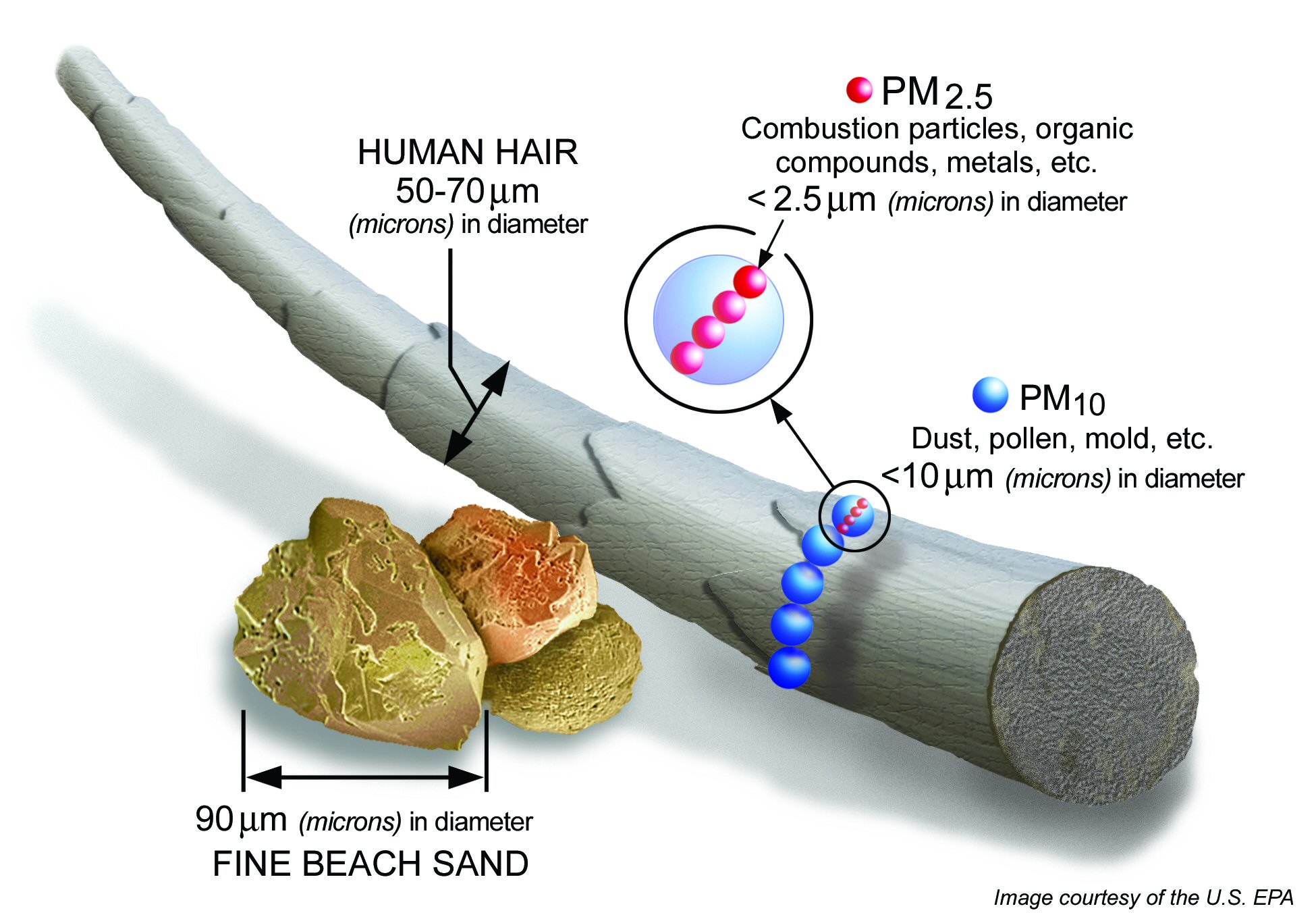
Check the latest Phuket reading →PM2.5 means airborne particles with diameters of 2.5 micrometres or less. A typical human hair is roughly 70 micrometres across. These particles are small enough to travel beyond the nose and throat into the lungs; some may reach the bloodstream.
Particle pollution is a mixture. It can come from combustion and other emissions, or form in the atmosphere from gases. Traffic, burning and industry are possible contributors in general. This dashboard measures concentration; it cannot identify which source caused a particular Phuket reading. EPA: particle pollution basics.
Fine-particle exposure can worsen asthma, reduce lung function and contribute to coughing, wheezing or difficulty breathing. The concern goes beyond irritation that you can immediately notice.
Particle pollution is linked to heart attacks and irregular heartbeat, as well as premature death in people with heart or lung disease. A pollution problem does not have to feel like a breathing problem.
Source: EPA’s summary of particle-pollution health effects.
The International Agency for Research on Cancer classifies outdoor air pollution and particulate matter as carcinogenic to humans, with sufficient evidence for lung cancer. That describes the strength of the evidence for a hazard. It does not mean that a particular holiday or AQI reading will cause cancer, or quantify an individual person’s risk. IARC assessment (PDF).
Yes, short-term exposure deserves attention. EPA describes cardiovascular effects associated with exposure over hours to days, alongside the risks of repeated exposure over months and years. Having only a few days in Phuket is not a reason to ignore a pollution episode. EPA: exposure duration and cardiovascular effects.
For an expat, seasonal resident or repeat visitor, a single low reading tells little about the pattern over a longer stay. Use the daily archive and monthly comparisons to examine actual dates. These outdoor observations are context—not a measurement of what you personally inhaled indoors, in traffic or at a particular beach.
During hard exercise you breathe more air, increasing the particle dose at a given concentration. Consider the timing, duration and intensity of a run, bike ride or outdoor workout when readings rise. Moving the session to cleaner indoor air can preserve the benefits of exercise. EPA: how exposure works.
People with heart or lung disease, including asthma and COPD, children and teenagers, older adults and pregnant people should take extra care. People who work outdoors may receive more exposure because of the time they spend outside. Plan around both the reading and individual health needs. AirNow’s particle-pollution guide (PDF).
Feeling fine is not a dependable air-quality test. EPA notes that exposure can occur without immediate symptoms, even at relatively high concentrations. Follow any personal care plan from your clinician rather than waiting for discomfort. EPA: symptoms and exposure.
The US AQI helps communicate near-term pollution concern. Good (0–50) means little or no expected risk under that category; Moderate (51–100) is generally acceptable, although unusually sensitive people may be affected. This site groups Moderate and worse as Not Good (AQI above 50) because they are outside the Good range. Above 100, advice becomes more protective, starting with sensitive groups. AirNow: AQI categories.
Those labels are useful, but they are not a guarantee that any exposure is harmless. WHO reports health effects at low particle concentrations and has not identified a threshold below which no harm occurs. Reducing avoidable exposure still has value. WHO: air-quality and health training, guideline summary (PDF).
WHO’s short-term PM2.5 guideline uses the 99th percentile of daily values—about 3–4 days above this level per year.
WHO’s long-term PM2.5 guideline applies to the average across a year.
These are WHO health guidelines, not Thai legal limits or another AQI scale. Compare like time periods: a two-minute reading is not a 24-hour average, and a month of observations is not an annual assessment. Our selected-source indicator also cannot establish formal compliance for the whole island. WHO’s guideline table and averaging conventions.
The site uses the updated US PM2.5 AQI scale, with the 2024 Good boundary of 9 µg/m³, while retaining its original calculation. The live result is indicative, not an official EPA NowCast. Read the calculation and limitations.
Yes. Individual fine particles are too small to judge by looking across a bay. Air pollution can be present without an obvious visible warning. Sea views and holiday photographs cannot replace a measurement. EPA/AirNow: pollution is often invisible (PDF).
The homepage’s gray overlay is an illustration driven by AQI. It is not a live photograph or a model of visibility, and cannot tell you how a beach looks right now. Check the observation time, then use the exposure-reduction guide to make practical choices.
Prepared by Phuket Air Quality from the primary sources linked above. Sources checked . General health education; individual advice should come from a qualified healthcare professional.